
Bat recordings from Fforest Farm
Bats are easy to overlook. We see them moving along a hedgerow at dusk, or hunting above the lake, but their lives are largely conducted out of sight and beyond our hearing. The recordings give us a rather different picture of what happens here after dark.
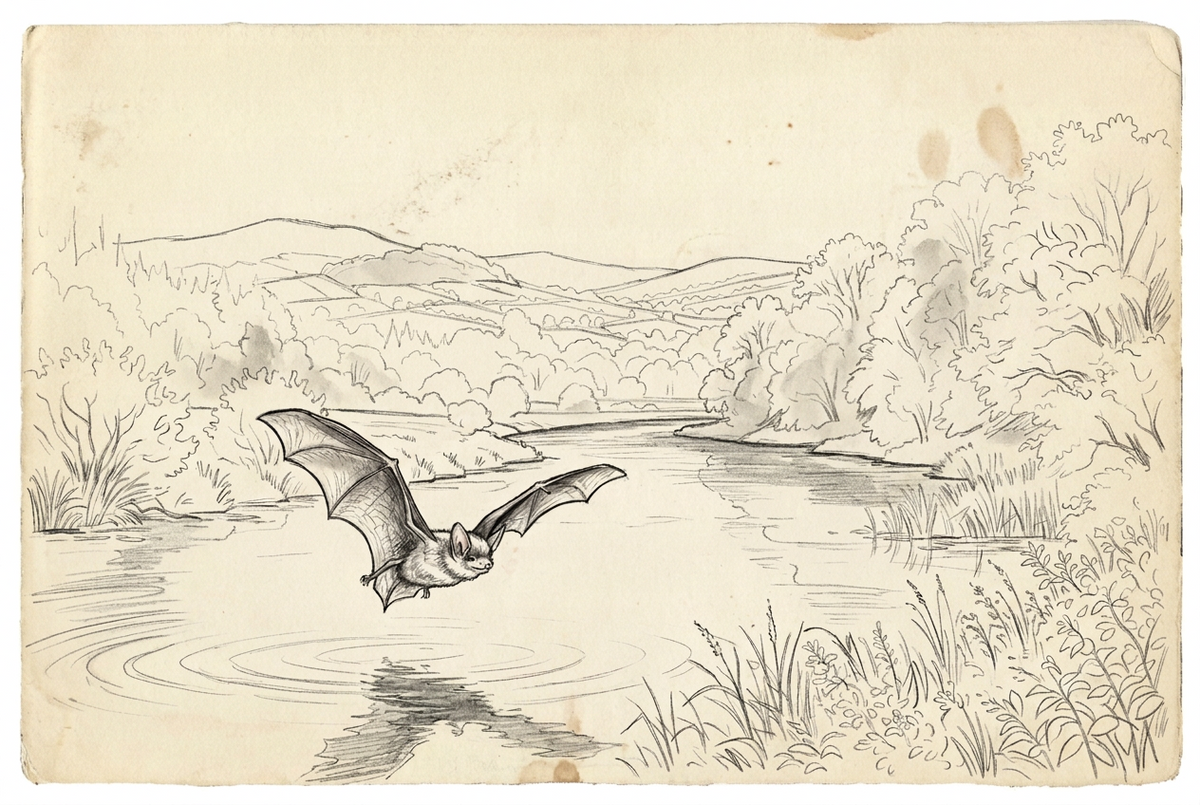
Date: September 2026
Location: Fforest Farm, near Builth Wells
Recorded by: Sorcha Lewis
Method: Static ultrasonic bat detector, attached to a tree
Duration: Seven nights
Results: More than 2,000 recordings; nine bat identification groups
For seven nights, Sorcha Lewis, the Radnorshire County Mammal Recorder from the Elan Valley, kindly left a bat detector attached to a tree on the farm recording the ultrasonic calls of bats passing within range.
Species recorded
The results identified nine bat recording groups. They include some of Britain's more familiar bats, several woodland and water-associated species, and two particularly interesting records: Nathusius' pipistrelle and barbastelle.
01. Common pipistrelle
Pipistrellus pipistrellus
One of Britain's smallest and most widespread bats, weighing roughly as much as a 20p coin. Common pipistrelles hunt tiny flying insects, often following hedgerows, field margins and woodland edges. Their flight is quick, with frequent changes of direction. A familiar bat, but an important part of the farm's insect-eating wildlife.
02. Soprano pipistrelle
Pipistrellus pygmaeus
Very similar in appearance to the common pipistrelle, but calling at a higher frequency. Soprano pipistrelles particularly favour waterside habitats, feeding on midges and other small insects around lakes, rivers and trees. The farm's lakes and wet ground provide the sort of habitat this species uses, although the recording alone doesn't tell us where it was feeding.
03. Nathusius' pipistrelle
Pipistrellus nathusii
A particularly interesting identification. Nathusius' pipistrelle is less frequently recorded in Britain and is known for its remarkable migrations across Europe. Some remain in the UK throughout the year, while others arrive seasonally. It is often associated with water and woodland. Further recordings would help establish whether this is an occasional visitor or a regular user of the farm.
04. Daubenton's bat
Myotis daubentonii
Sometimes called the water bat. Daubenton's bats are extraordinary hunters, flying just centimetres above the surface of lakes and rivers, taking emerging insects and occasionally scooping prey from the water with their feet. One to look out for over the lakes on a still summer evening.
05. Natterer's bat
Myotis nattereri
A woodland hunter, capable of remarkably slow and manoeuvrable flight. Rather than catching everything in mid-air, Natterer's bats can pick insects and spiders from leaves, branches and webs. They use woodland, hedgerows and older buildings, making them an interesting species to follow as our recording work develops.
06. Noctule
Nyctalus noctula
One of Britain's largest bats, with a wingspan of up to about 40 centimetres. Noctules often emerge early, sometimes while there is still light in the sky, and fly high and fast over open country. They roost primarily in trees and can travel considerable distances to feed. A recording tells us one passed within the detector's range, rather than where it spends the day.
07. Brown long-eared bat
Plecotus auritus
Known as a 'whispering bat' because its echolocation calls are exceptionally quiet. Its enormous ears allow it to listen for insects moving among leaves and branches. Brown long-eared bats often hunt close to vegetation, picking moths and other insects from surfaces. Their quiet calls make them relatively difficult for detectors to pick up.
08. Barbastelle
Barbastella barbastellus
Perhaps the most significant identification in the results. Barbastelles are uncommon, woodland-associated bats, classified as vulnerable in Wales. They have distinctive broad ears that meet across the forehead and feed particularly on small moths.
They are associated with landscapes containing mature trees, woodland edges, wet meadows and good insect habitat. Because of their conservation importance, this is a record worth checking carefully and following up with further monitoring.
09. Whiskered / Brandt's bat
Myotis mystacinus / Myotis brandtii
These two small woodland bats have very similar echolocation calls and can be difficult to separate from acoustic recordings alone. The result therefore remains grouped rather than being assigned confidently to either species.
Both use woodland edges, hedgerows and sheltered feeding routes. More detailed investigation may help us understand which is present, or whether both occur here.
What the recordings tell us
More than 2,000 recordings is a substantial result from a single detector in one position over one week.
It is not a count of individual bats. The same animal may pass repeatedly, and one feeding bat can generate many recordings. Nor can we conclude from this survey that any of the species are roosting in the tree or elsewhere on the farm.
What the results do show is a varied collection of bat calls, from species with different feeding habits and habitat requirements.
There are bats associated with open country, woodland, hedgerows and water. Some are widespread; others are much less frequently encountered. The whiskered/Brandt's identification remains unresolved, and unusual acoustic identifications should be verified before being entered as confirmed species records.
Next observations
We intend to continue recording, moving detectors between the lakes, woodland, hedgerows and higher ground, and repeating the work at different times of year.
It will be useful to see which species appear consistently, whether activity differs between habitats, and what changes as the seasons turn.
The recordings are also a reminder of how much wildlife is present without our noticing it. A tree that seems fairly quiet during the day may stand beside a busy flight path after sunset.
Field Notes is our continuing record of wildlife at Fforest Fields and the surrounding Radnorshire hills. Observations will be added as further surveys are completed.
